


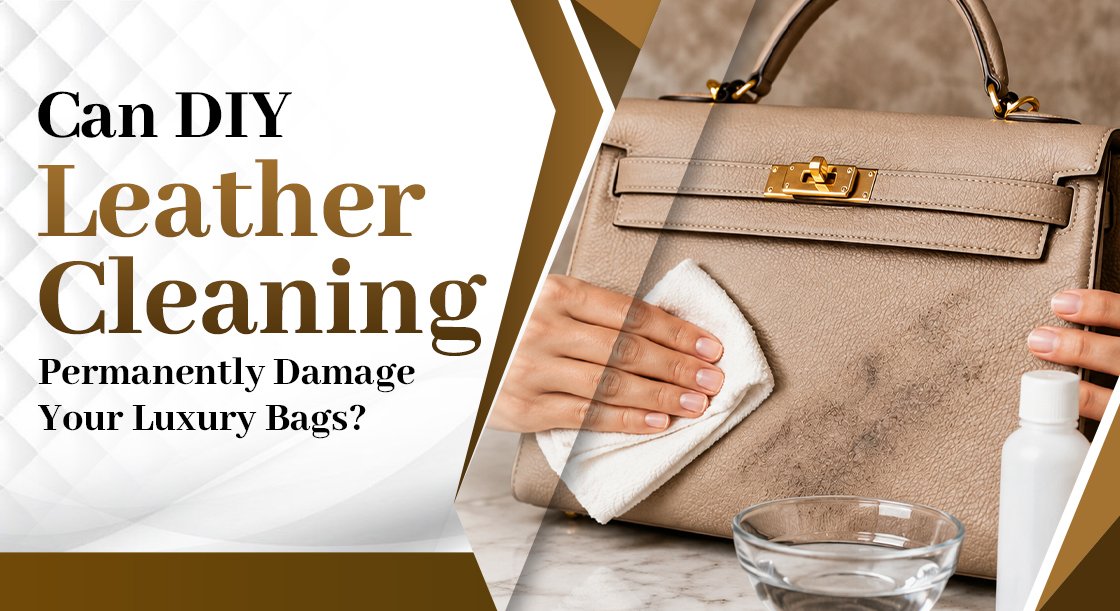
A woman once spilt coffee on a bag she'd owned for six years. She didn't call anyone; instead, she grabbed a wet cloth, then a stain remover from under the sink, and a hairdryer to speed things along. By the time she looked up, the stain was gone and so was everything that had made the leather feel alive. What was left felt stiff and patchy, nothing like the bag she'd carried for six years.
This is the story behind most leather bag care tips that go wrong, and it happens far more often than owners like to admit. DIY leather cleaning isn't wrong by default; wiping off dust with a soft cloth is DIY and fine. The problem starts when household products come into contact with a material that doesn't forgive mistakes the way fabric does.
Why Leather Punishes Mistakes Differently
Fabric can usually absorb a wrong move, but leather can't. Once you strip its natural oils, discolour its dye, or overwork its surface, there's often no undoing it, only disguising it. That's the core reason leather cleaning mistakes tend to be permanent rather than temporary, unlike most fabric mishaps.
Leather has skin-like pores, natural oils, and a finish calibrated during tanning to a very specific balance. Household products are built for glass, tile, and countertops, not for a material with that kind of chemistry. When they meet, the leather usually loses.
The Most Common DIY Leather Cleaning Mistakes
Most damage doesn't come from neglect. It comes from owners trying to do the right thing with the wrong tools, which is exactly how the most common leather cleaning mistakes happen.
Using water directly on the surface: Leather absorbs moisture quickly, and excessive moisture can leave rings, warping, or a stiff patch once it dries.
Reaching for baby wipes or makeup remover: These are formulated with alcohol and skin-moisturisers, and they strip leather's natural oils rather than protect them.
Applying household cleaners with alcohol or ammonia: Both aggressively dry out leather and can dull or discolour the finish in a single use.
Using a hairdryer or heater to speed up drying: Heat pulls moisture out fast, and leather that dries too quickly cracks.
Skipping the spot test: Applying anything new directly to a visible area, without testing it somewhere hidden first, is one of the fastest ways to turn a small problem into a permanent one.
Over-conditioning: More conditioner doesn't mean more protection. Too much buildup attracts dust and leaves leather feeling tacky rather than supple.
Each of these starts as a reasonable idea. None of them accounts for how unforgiving leather can be once it's been altered, and that gap is where leather-cleaning mistakes quietly turn expensive.
What It Actually Costs to Get This Wrong
Professional leather cleaning is priced the way it is for a reason. The products are pH-balanced, precisely matched to your leather type, and cost more than anything else sitting under your sink. Comprehensive repairs, the kind that include colour correction after a failed cleaning attempt, cost even more, and once you understand what's involved, it's easy to see why.
Here's the part that stings most: $20 in home products for a DIY attempt vs. $100–$120 for the professional fix that often follows when a DIY attempt goes wrong. The cost of a mistake isn't just the mistake. It's undoing it too.
Signs Your Bag Has Already Been Damaged
Some damage from DIY leather cleaning shows up immediately. Some takes weeks to fully reveal itself.
Stiffness or a rough texture where the leather used to feel soft, usually a sign the natural oils have been stripped.
Uneven colour or a faded patch exactly where a cleaner or wipe was applied.
A slightly plastic or waxy sheen where a heavy product has sat on the surface rather than absorbed.
Small cracks along a fold or edge, often the delayed result of moisture loss from over-cleaning or improper drying.
A lingering smell from a cleaning product that was never designed for leather in the first place.
If you're noticing any of these, the leather is already asking for help; the question is just how much.
What Genuinely Safe Leather Bag Care Tips Look Like
None of this means you should never touch your own bag. It means knowing where safe DIY leather cleaning ends and where the line sits.
Dust and wipe regularly with a soft, dry cloth. This alone prevents most of the buildup that would otherwise tempt people to resort to harsher cleaning.
Use only leather-specific cleaners and conditioners, and always test them on a hidden spot first.
Blot, never rub, when dealing with a fresh spill. Rubbing pushes the stain deeper and spreads it further.
Let leather air-dry naturally, away from direct heat or sunlight, if it gets wet.
Condition sparingly, a few times a year, rather than treating it as a weekly ritual.
These habits cover the vast majority of what a bag needs day-to-day, and as far as leather bag care tips go, they carry essentially none of the risk that comes with improvised fixes.
When to Stop and Call a Specialist
There's a clear line between everyday leather bag care tips and situations where leather restoration or a specialist becomes necessary. Deep stains, colour loss, cracking, or any damage on suede, nubuck, or exotic leathers should never be handled with home remedies. These materials and problems require tools and expertise that don't exist in a bathroom cabinet.
A good specialist doesn't just fix the visible issue. They assess why it happened, correct it without disturbing the surrounding leather, and tell you honestly whether the damage was caused by DIY leather cleaning in the first place, so you know what to avoid in the future.
Final Word
Leather rewards patience and punishes shortcuts, and that's really the whole story behind why so much DIY leather cleaning ends in disappointment rather than the savings it promised. A five-minute fix can quietly cost far more than the professional service it was meant to avoid, both in money and in a finish that never quite looks the same again. Knowing the handful of leather-cleaning mistakes to avoid and which leather bag care tips are genuinely safe to do yourself is what protects a bag better than any single cleaning session ever could.
At House of Skoria, we see the aftermath of well-intentioned DIY attempts more often than we'd like. If your bag needs more than a simple wipe-down, it deserves hands that know exactly what the leather can and cannot handle.
Book your Preservation Assessment with House of Skoria today, and let artisans tell you what your bag actually needs.