


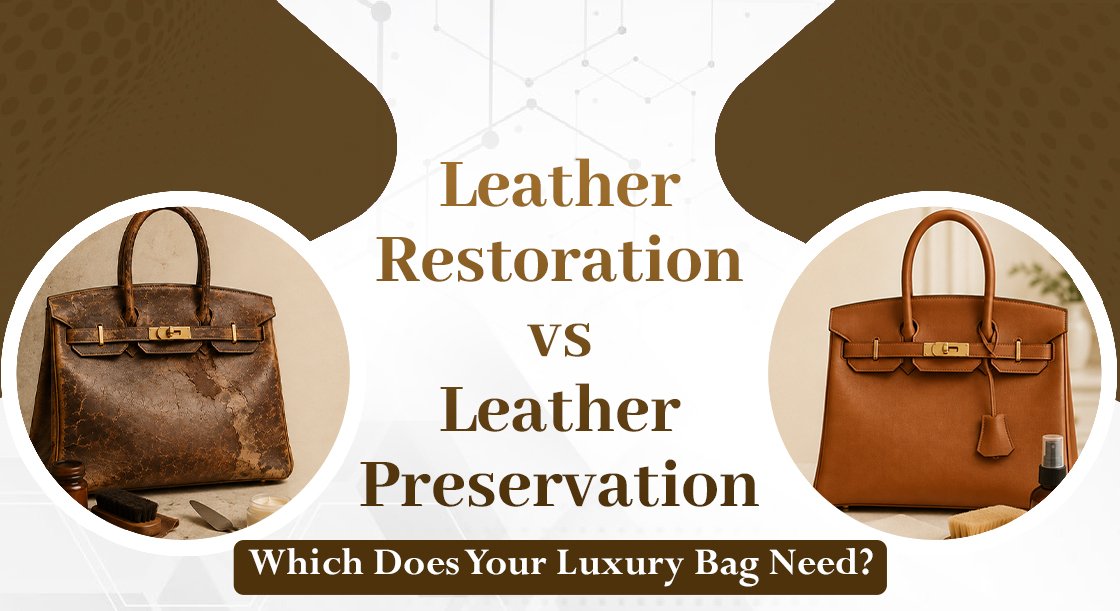
At some point, every owner of a fine leather bag asks the same question: does this need restoration or just preservation? The two are used interchangeably all the time, and that's where most people get their bag care completely wrong.
Understanding the difference isn't just a matter of vocabulary. It's the difference between spending on the right service at the right time, or spending twice, once on the wrong fix, and again on the one that was actually needed. Real luxury leather care starts with knowing which of these two, leather restoration or leather preservation, your bag is actually asking for. According to the Knight Frank Wealth Report 2025, luxury handbags have appreciated 85.5% over the past decade, outperforming art, wine and many traditional collectables. That number only applies to articles that have been properly cared for [Knight Frank Wealth Report 2025].
Preservation: Care Before There's a Problem
Leather preservation is what you do while your bag is still in good condition, to keep it that way. Think of it as maintenance, not intervention. It's the conditioning, the cleaning, the proper storage, the small habits that stop damage before it ever begins.
Cleaning removes surface dust, oils, and residue before they settle in and permanently dull the leather.
Conditioning replenishes the natural oils leather loses through daily use and exposure to air.
Correct storage protects shape and colour when the bag isn't being carried.
Routine inspection catches early wear at corners, handles, and stress points before it becomes visible damage.
This is the kind of luxury leather care most owners can build into their routine without needing a specialist every time. When done consistently, leather preservation is genuinely the inexpensive form of leather care, because it prevents expensive problems from ever showing up.
Restoration: Fixing What's Already Gone Wrong
Leather restoration comes in after something has already happened. Cracking, deep staining, colour loss, dried-out patches, torn stitching, a handle that's lost its shape entirely. This isn't maintenance anymore; it's repair, and it requires a different level of skill altogether.
Recolouring corrects fading or uneven colour caused by years of light exposure or handling.
Reconditioning brings moisture back into leather that has dried out and started to crack.
Structural repair addresses torn seams, damaged corners, or handles that have weakened under stress.
Deep cleaning removes staining and discolouration that surface wiping alone can never reach.
Leather restoration is specialist work for identifying the exact type of leather, precisely matching the dye and finish, and using techniques that aren't part of a home care routine. Attempting it yourself, with off-the-shelf products, usually makes the damage worse before it gets better.
How to Tell Which One Your Bag Actually Needs
Most owners can tell the difference with a fairly simple gut check.
If your bag looks the way it did when you bought it, just a little softer with use, it needs leather preservation.
If it has visible cracking, patches of faded or uneven colour, stiff or brittle areas, or loose stitching, it needs leather restoration.
If you're not sure which one applies, that uncertainty is usually itself a sign that a professional assessment is overdue.
The honest answer is that most bags don't need leather restoration at all, if leather preservation had been happening consistently from the start. Restoration is necessary because preservation was skipped, delayed, or done incorrectly long enough that the leather couldn't recover on its own.
Why the Distinction Actually Matters
Treating a restoration problem with a preservation routine doesn't work. Conditioning a bag with deep cracks does nothing to address the structural damage beneath the surface. On the other hand, sending a perfectly healthy bag in for a full restoration is unnecessary, and can sometimes do more harm than good, since restoration processes are more intensive by design and aren't meant for leather that doesn't need them.
This is why genuine luxury leather care always starts with an honest assessment, not a default service, since real luxury leather care means treating restoration and preservation as two entirely different jobs. A good specialist will tell you whether your bag needs full leather restoration or simply consistent leather preservation going forward.
The Cost of Getting It Wrong
Skipping preservation is what makes restoration inevitable. Leather that isn't conditioned dries out, and leather that isn't cleaned accumulates oils and residue that darken and degrade the surface over time. When stored incorrectly in plastic, in direct sunlight, or folded under its own weight, leather ages far faster than it should.
By the time most owners notice something is wrong, they're already looking at a leather restoration job rather than a leather preservation one. And restoration, by nature, costs more, takes longer, and can never fully undo years of neglect. A bag that has been properly restored will look remarkably close to its original condition, but it will never be quite the same as one that was preserved correctly from day one.
This is really the strongest argument for building consistent luxury leather care into how you own a bag from the moment you buy it, rather than waiting until leather restoration becomes the only option left.
Chanel and Louis Vuitton bags have reached resale retention rates of 92% and 88% respectively, but those figures reflect articles in well-maintained condition. Visible deterioration changes that number significantly the moment an article is assessed on the secondary market [retyche]
Building a Routine That Actually Works
The best approach to luxury leather care isn't a one-time decision, such as leather restoration or preservation. It's preservation as an ongoing habit, with restoration available as a safety net for damage that happens regardless, because even the most careful owner deals with an unexpected stain or a scuff.
Build simple preservation habits into your daily bag use: wipe it down, avoid overfilling it, and keep it away from rough or wet surfaces.
Schedule conditioning a few times a year as part of ongoing leather preservation, not as an emergency response.
Get an annual professional assessment, even if nothing looks wrong. This is where early signs of damage get caught before they require full restoration.
Conclusion
Leather restoration and leather preservation aren't competing services; they're two sides of the same care for your bag. One keeps things from going wrong. The other fixes things once they already have. Knowing which one your bag needs, and more importantly, building a routine that keeps you on the preservation side of that line as often as possible, is what real luxury leather care actually looks like.
The global luxury leather goods market is projected to exceed $105 billion by 2033, and demand for handcrafted goods has grown by 26% since 2022. The world is placing more value on exceptional craft, not less. Preservation is not just the right decision. At this point, it is the obvious one [SkyQuest Market Research 2025]
At House of Skoria, every bag that comes through our atelier gets an honest answer. Sometimes that means a straightforward leather preservation service. Sometimes it means full leather restoration. Both are part of the same commitment to genuine luxury leather care.
Book your Preservation Assessment with House of Skoria today, and discover exactly what your bag deserves to look effortlessly refined for years to come.